Poker Quiz! A♣4♣ Vs The Small Blind, what do you do here?
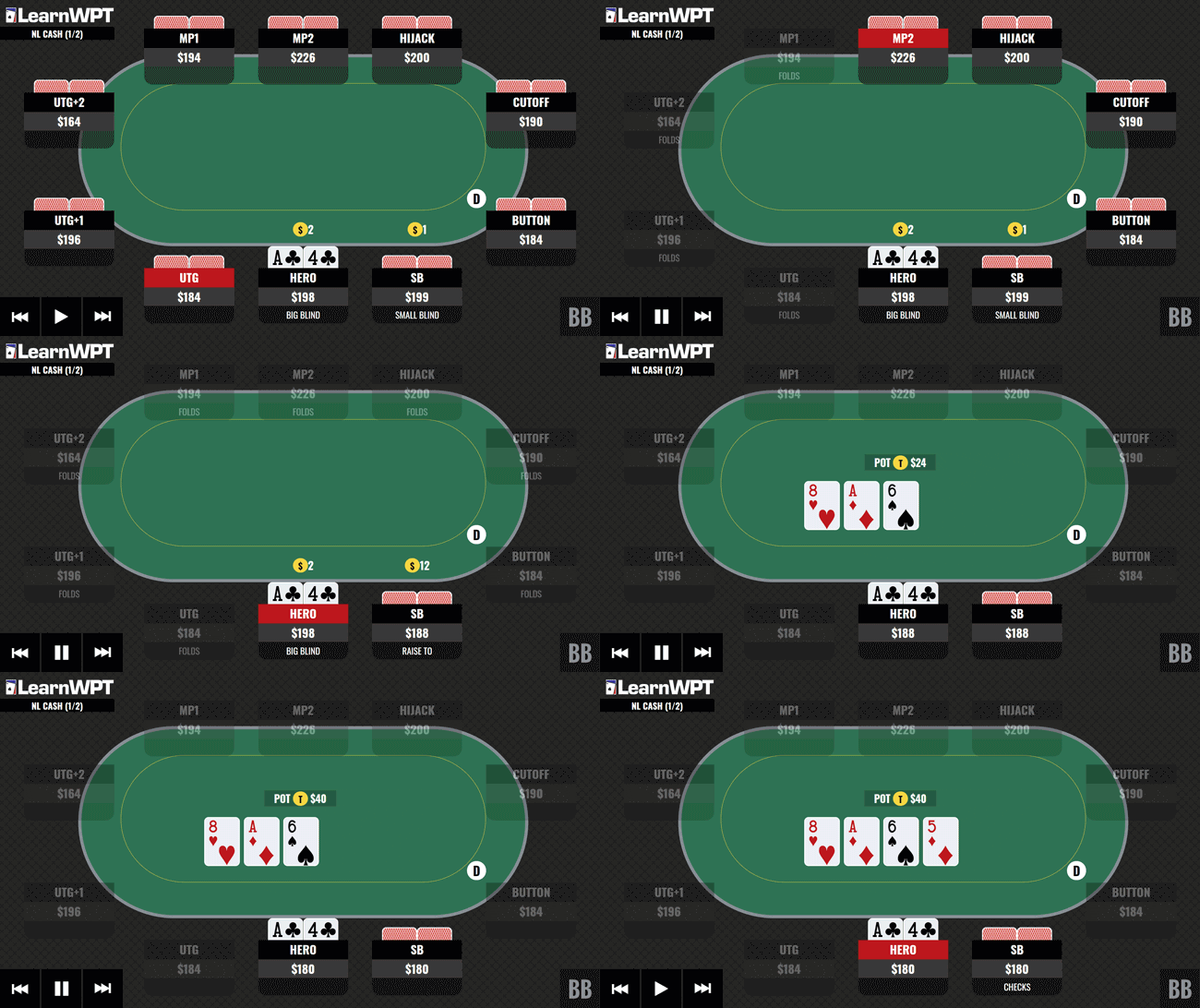
DECISION POINT: In a $1-2 game where the typical open raise size is 5-6x, the action folds to the Small Blind (observed to be a strong player) who raises to $12 and you call from the Big Blind with A♣4♣. The Small Blind c-bets $8 on the 8♥A♦6♠ flop and you call. The turn is the 5♦ and your opponent checks. Action is on you, what do you do here?
PRO ANSWER: We are playing a $1-2 cash game where there are large opening raise sizes, often as large as 5-6x the big blind. The stacks are 100BBs deep and we are dealt Ac4c in the Big Blind. The action folds to the Small Blind, who we’ve observed to be a strong and aggressive opponent, and they open to $12.
Against this particular raise sizing, the Small Blind’s range should be fairly linear even though we are still deep stacked. While it is likely also wide, it’s not as wide as if the Small Blind were using a smaller sizing or were on the Button where they’d be in position deep stacked postflop.
While suited wheel aces often make decent 3-betting candidates, against this large of a sizing 3-betting can be awkward as it will often create a pot of around 30-35BB pot postflop with stacks of around 85BBs behind.
A significant part of our edge playing wide range vs wide range in position comes from our ability to apply pressure in multiple spots postflop. Bloating the pot too much preflop negates some of that positional edge as stacks will quickly get all-in. We do call and the flop is 8hAd6s.
Continued below...
This flop typically hits the Small Blind’s range better than ours and given it’s an ace high, dry flop our opponent should be continuation betting most of their range at a smaller sizing. They do c-bet $8 and action is on us.
Our hand benefits a lot here from keeping many of the Small Blind’s bluffs in their range. Hands like KJs would fold to a raise but could turn second pair and potentially pay off another bet. We wouldn’t need protection from most of their range, given the number of hands the Small Blind bets with here is a very small overall % of their range and 97s is the only realistic draw. Calling here clearly the best play and that’s what we choose to do.
The turn is the 5d and our opponent checks. Many players are tempted to bet in our spot here, and if you’re in a game where players play quite passively and would call down with 2nd or 3rd pair and almost never check-raise bluff the turn, then betting this turn might make sense. We’re against a tough, aggressive opponent though that knows we should be floating quite light on the flop and could therefore have a robust check-raising range on the turn.
Our hand is really only worth two streets of value at the most in this specific situation. We’re much better off either inducing a bluff on the river or making a small value bet if the Small Blind checks to us a second time, rather than exposing ourselves to a potential check-raise.
Checking is the best play.
How would you play it?
Share your answer in the comments below!
THE WPT GTO TRAINER
The Fastest Way to Learn GTO Strategy
The WPT GTO Trainer allows you to Play and Train against True GTO Opponents and get real-time Feedback and Analysis on Your Actions.
Choose from Cash Game and Tournament scenarios (including Small Stakes cash games) and receive immediate feedback on YOUR play compared to GTO including EV (expected value) Loss, Percentage Played, and the Ideal Action.
Click the button below and play the WPT GTO Trainer for free....
Join LearnWPT.com for just $5 your First Month of Membership and play through hundreds of solved hands per hour (anytime, anywhere, and as many hands as you want) on the WPT GTO Trainer!